Table of contents
- What is a ridangil?
- Gyeongnidan-gil & Haebangchon — the original and its neighbour
- Songnidan-gil — Seokchon Lake and a street that had its moment
- Yongnidan-gil — Yongsan's quietly thriving street
- Sharosu-gil — the street I grew up next to, transformed
- Mangnidan-gil — the most local-feeling ridangil in Seoul
- Yeonnam-dong — the relaxed, green alternative to Hongdae
- Practical tips for exploring the ridangil streets
- Final thoughts — Seoul's alleyways keep reinventing themselves
What is a ridangil?
If you've been researching Seoul and keep seeing names like Gyeongnidan-gil, Songnidan-gil, or Sharosu-gil, you might be wondering what they all have in common. The answer is one street: Gyeongnidan-gil in Itaewon, the original ridangil, which gave its suffix to every neighborhood street that followed.
The name "Gyeongnidan" came from the old Army Finance Corps (육군중앙경리단) that was once based in the area. When the street became one of Seoul's most talked-about destinations in the early 2010s — full of independent cafés, foreign restaurants, and a distinctly non-mainstream energy — other neighborhoods with similar character started borrowing the "ridangil" suffix. Mangnidan-gil (망원동), Songnidan-gil (송파·잠실), Yongnidan-gil (용산) — the formula spread quickly.
What all these streets share: they're not purpose-built tourist zones. They grew organically from residential neighborhoods — a few interesting cafés, then a few more, then a reputation. The appeal is the feeling of discovering something rather than being directed toward it. Walking without a plan, finding a place that looks interesting, going in — that's the ridangil experience.
Gyeongnidan-gil & Haebangchon — the original and its neighbour
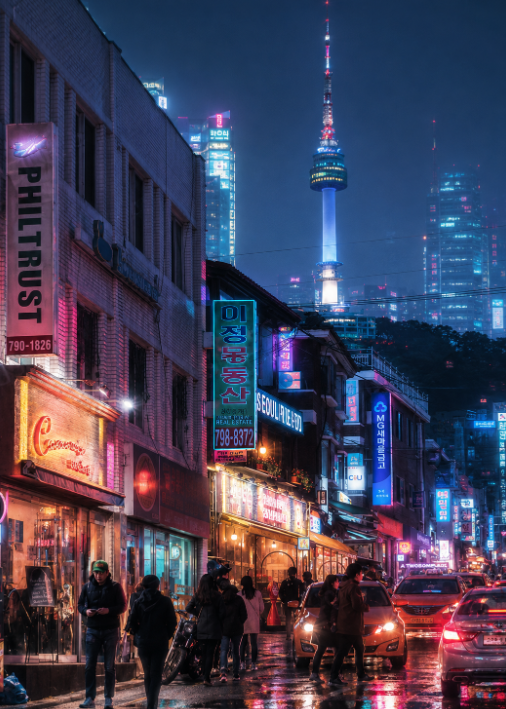
Gyeongnidan-gil is where everything started. It runs through the Itaewon neighborhood toward Namsan, and I spent a lot of time here in my 20s while working in the area. For shooting content — photos, videos, anything that needed atmosphere — this street was unbeatable. The gamaek culture (편의점 가맥, drinking canned beer at outdoor tables in front of convenience stores), the small Italian restaurants, the vintage shops — every frame had character. I kept coming back because the place kept giving.
The street got genuinely famous — then, like most genuinely famous streets, it changed. Rents rose, the original independent shops that made it interesting moved out, and the identity softened. Gyeongnidan-gil today is quieter than its peak years, but it still has something the newer imitators don't quite replicate: a certain worn-in authenticity, and views toward Namsan that no amount of trend-cycling can take away.
The real recommendation, though, is to combine it with Haebangchon (해방촌) — the neighborhood that runs adjacent to Gyeongnidan-gil. Haebangchon is quieter, more local, and has a particular quality that I find hard to describe without sounding romantic about it. Narrow alleys, old houses next to new cafés, the sense of a community that existed before the tourists arrived and will exist after they leave. I always felt like I was walking through a film set whenever I was there. The Namsan views from the upper streets are genuinely beautiful. This combined walk — Gyeongnidan-gil into Haebangchon, ending somewhere elevated with a coffee — is one of my favorite Seoul afternoon routes.
Best for: The original ridangil experience, Haebangchon atmospheric walks, Namsan views, gamaek culture, content creation and photography
Songnidan-gil — Seokchon Lake and a street that had its moment
Songnidan-gil is the one closest to home for me — I live near Jamsil, which means I've walked this street more times than I can count. The natural pairing of Seokchon Lake and Songnidan-gil is genuinely lovely: a loop around the lake, appetite building, and then the street on the southern side with its cafés and restaurants waiting. That transition — lake air, then coffee — is a simple pleasure that reliably delivers.
I'll be honest about where Songnidan-gil stands right now, though. It's not what it was a few years ago. A lot of the most interesting shops have closed or moved. The places that made it feel genuinely special — the ones people were coming specifically for — many of them seem to have relocated to Seongsu-dong, which has become the new center of gravity for Seoul's independent creative scene. What's left is still pleasant, and the lake walk makes any visit worthwhile, but it would be misleading to describe it as one of Seoul's current hotspots.
For what it's worth, in cherry blossom season (early April), Seokchon Lake combined with a walk down Songnidan-gil is one of the most beautiful things you can do in Seoul. The combination of pink blossoms over the water and a café stop afterward — that version of this street is still very much alive. It also connects naturally with Lotte World, making it an easy addition to a Jamsil-area day.
Best for: Seokchon Lake combination walks, spring cherry blossom season, Lotte World day trips. Honest note: less buzzy than a few years ago, but still worth it for the lake.

Yongnidan-gil — Yongsan's quietly thriving street
Yongnidan-gil runs through the area between Samgakji Station and Sinyongsan Station in Yongsan, and unlike some of the other ridangil streets, it's genuinely current. This is a street that's been building momentum rather than coasting on past reputation, and the energy reflects that — new restaurants and cafés opening with intention, a neighborhood that feels like it's still in the process of becoming rather than already faded.
The Yongsan area has an interesting history — long associated with the presence of military bases, institutional buildings, and the kind of functional urban fabric that doesn't typically generate neighborhood cool. The transformation has been real and noticeable. The existing fabric of old local restaurants (the area was known for its unpretentious, long-running food spots) has been joined by a newer layer of design-conscious cafés and creative shops. The mix feels less forced than in some other ridangil streets. Accessible from both Samgakji and Sinyongsan stations on Line 4.
Best for: Current, active ridangil energy, mix of old local restaurants and new cafés, Yongsan area exploration
Sharosu-gil — the street I grew up next to, transformed
This one is personal. I grew up near Nakseongdae — the area around Seoul National University's main gate, where Sharosu-gil now is. And I want to be honest about what that neighborhood was when I was young: the alleys that are now full of charming cafés and young people taking photos were, back then, lined with motels. Narrow, dim, the kind of streets you didn't walk through at night if you could avoid it. There was an unnamed tteokbokki shop nearby that I used to go to constantly with friends in high school. It was nothing — a tiny place, basic menu, no decor — but we loved it the way you love everything when you're that age and nothing costs very much and time is easy.
I moved away, and the neighborhood became something I didn't recognize. The motel alleys became café streets. The dim corners became photogenic corners. When I first heard people talking about Sharosu-gil as one of Seoul's up-and-coming neighborhoods, I had to look it up to confirm I was thinking of the same place. I was. It's genuinely a kind of urban miracle — that a neighborhood I associated with unease has become somewhere people seek out for its atmosphere.
I want to take my kids there someday. Walk the streets I used to walk as a child, let them see where their mother grew up — and try to find the corner where that tteokbokki shop used to be, even if there's now a specialty coffee place there instead.
"Sharosu-gil" combines "sha" from Seoul National University (서울대 샤) with "garosu-gil" — a naming tribute to Seoul's well-known tree-lined street in Gangnam. The street reflects the student-driven culture of the area: independent cafés, affordable food, secondhand bookshops, small creative studios. Less polished than the more famous ridangil streets, which is exactly what makes it feel real.
Best for: Genuinely local atmosphere, student culture, affordable cafés and food, travelers who want Seoul away from the tourist circuit
Mangnidan-gil — the most local-feeling ridangil in Seoul
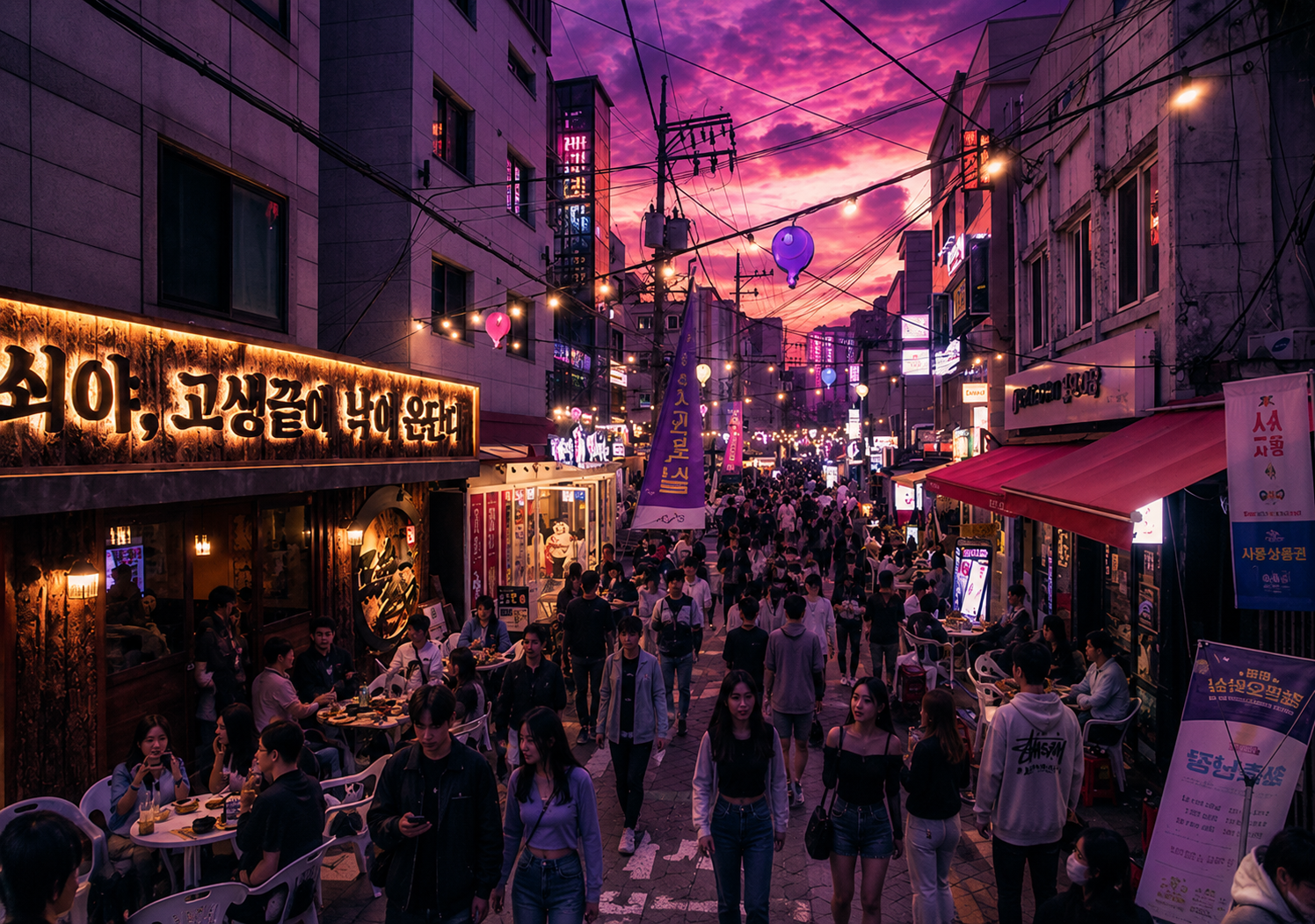
Mangnidan-gil in Mangwon-dong is the ridangil that feels least like a ridangil — which is meant as a compliment. There's almost no tourist infrastructure here. The cafés and restaurants exist because people who live nearby wanted them to exist, not because a neighborhood decided it needed a hip street. That distinction shows in everything: the pace, the clientele, the lack of that slightly performative quality that more famous streets can develop.
Pairing it with Mangwon Market is the natural move. The market is traditional, lively, and completely unpretentious — then Mangnidan-gil offers a quieter counterpoint for coffee or a meal afterward. The Han River's Mangwon section is also nearby, making a market → street → riverside evening a satisfying full sequence. All ages feel comfortable here in a way that isn't always true of the younger-skewing ridangil streets.
Best for: Most authentic local atmosphere of any ridangil, Mangwon Market combination, all ages, Han River Mangwon section nearby
Yeonnam-dong — the relaxed, green alternative to Hongdae
Yeonnam-dong isn't technically called "Yeonnam-ridangil" — the neighborhood goes by its own name — but it belongs in any honest guide to Seoul's ridangil-style streets because it embodies the same spirit and then some. It sits directly next to Hongdae, which means it benefits from the proximity without the noise.
The Gyeongui Line Forest Park (경의선 숲길) — sometimes called "Yeonntral Park" by locals — runs straight through the middle of the neighborhood. A long, linear green space threaded through the urban fabric, with benches and trees and the occasional remnant of the old railway track. Walking it in spring or autumn is one of those low-key Seoul experiences that quietly becomes a highlight of the trip.
The cafés and restaurants around Yeonnam tend toward quality over quantity. The aesthetic is European-adjacent in a way that never feels forced — building proportions, old trees, the way afternoon light comes through the gaps. It's a neighborhood that rewards slow walking more than most. Arriving from Hongdae and letting Yeonnam-dong slow you down is one of the better Seoul transitions you can make.
Best for: Gyeongui Line Forest Park walk, post-Hongdae decompression, cafés worth lingering in, 20s–30s travelers
Practical tips for exploring the ridangil streets
When to go
Weekday afternoons are the sweet spot for almost all of these streets. Weekend crowds at Yeonnam-dong and the Seokchon area can be significant. If you want the experience of wandering without navigating around other people's photo shoots, a Tuesday or Wednesday afternoon is a completely different proposition from a Saturday.
How to get there
Most ridangil streets are within walking distance of a subway station — Naver Maps gives the most accurate walking directions for these narrow neighborhood streets. Driving is not recommended for any of them: parking is extremely limited and the streets themselves are often too narrow for comfortable car navigation. Take the subway and walk.
What to budget
Coffee at ridangil cafés typically runs ₩6,000–9,000. Meals are generally ₩10,000–20,000 per person. These are local prices — noticeably more affordable than hotel-area dining, and often significantly better in quality.
The best approach
Don't over-plan. The ridangil experience is about discovery — a place that looks interesting through a window, a side alley that wasn't on any list you read. Pick a neighborhood, pick a starting point, and walk. The streets will do the rest.
Final thoughts — Seoul's alleyways keep reinventing themselves
One of the things I find most interesting about Seoul's ridangil culture is how it moves. A neighborhood becomes interesting, becomes famous, becomes expensive, and the interesting things inside it gradually migrate somewhere else — which then becomes interesting, famous, expensive, and so the cycle continues. Songnidan-gil's energy moved to Seongsu-dong. Gyeongnidan-gil's intensity cooled and Haebangchon absorbed some of what left. Yongnidan-gil is having a moment that will eventually move somewhere too.
For a visitor, this is mostly good news. It means there's always somewhere in Seoul where the energy is fresh and the prices haven't yet caught up with the reputation. The ridangil streets are a good way into that Seoul — the version that exists between the palace visits and the department stores, in the places where people actually live and the cafés exist because someone thought they should.
Pick one street, walk it without a plan, and find something you weren't looking for. That's the whole idea. Have an amazing trip!


