Table of contents
- Intro — knowing the culture makes everything better
- Greetings and basic courtesy
- Dining etiquette
- Drinking culture etiquette
- Public transport etiquette
- Shopping and store etiquette
- Temple and traditional spaces
- Home visit etiquette
- Language and communication tips
- Final thoughts — Koreans appreciate the effort
Intro — knowing the culture makes everything better
A lot of first-time visitors to Korea worry about making a cultural mistake. And I completely understand that feeling — every country has its own unspoken rules, and getting it wrong can feel awkward even when nobody says anything. But here's the honest truth: Koreans are genuinely understanding toward foreign visitors. Small cultural missteps from someone who's clearly trying are almost always met with warmth, not judgment.
That said, knowing a few things in advance really does change the experience. When you show even a small awareness of Korean customs — the bow, the two-handed gesture, a few words of Korean — the response from locals shifts noticeably. Doors open a little more easily. Smiles come a little more readily. The trip feels like more than just sightseeing.
This guide isn't a list of rules to follow out of fear. It's a collection of things that, if you do them, will make your time in Korea genuinely richer. Think of it as the local playbook for making good impressions — presented with the spirit of "here's what works" rather than "here's what not to do."
Quick summary: Use two hands when giving and receiving. Let elders go first. Stay quiet on the subway. Remove shoes when asked. Say thank you in Korean. That's honestly most of it.
Greetings and basic courtesy
The bow — the universal Korean greeting
In Korea, the standard greeting is a bow — a slight forward tilt of the head and upper body. A gentle 15-degree nod works for most everyday situations — entering a shop, meeting someone for the first time, thanking a server. The deeper the bow, the more respectful the gesture. You don't need to go all the way — a natural, unhurried nod communicates plenty. Handshakes happen too, but in more formal contexts. When in doubt, bow.
When foreign visitors bow, even casually, Koreans tend to respond warmly. It signals awareness and respect, which goes a long way here regardless of whether you speak a word of Korean.
The two-handed gesture
This is one of the most important things to know. When giving or receiving anything — an object, money, a business card, food, a gift — use both hands. Or at minimum, offer with your right hand while your left hand lightly supports your right forearm or elbow. This applies especially with older people. It's a small gesture that communicates a lot of respect in Korean culture, and people genuinely notice it. Koreans who receive something with two hands from a foreign visitor often light up a little — it's unexpected and appreciated every time.
"Gamsahamnida" — the one Korean phrase that opens everything
You don't need to learn Korean to travel here comfortably. But if you learn one phrase, make it "gamsahamnida" (감사합니다) — thank you. Use it when leaving a restaurant, when someone helps you with directions, when a shopkeeper wraps your purchase. Said sincerely, it produces a reaction that's hard to describe — a kind of genuine warmth that you just don't get from silence or an English "thanks." Korean locals respond to the effort in a way that feels real.
Dining etiquette
Wait for the eldest to start eating first
In Korean dining culture, the eldest person at the table picks up their spoon first, and that's when everyone else begins. This matters most in situations where you're eating with Korean locals — a home-cooked meal, a family restaurant setting, any gathering where age differences are visible. Watch for the moment the eldest person reaches for their utensils, and follow their lead. It's a small act of deference that means a great deal in this culture.
Keep bowls on the table
Unlike Japanese and some Chinese dining customs where lifting bowls is normal, in Korea, rice and soup bowls stay on the table. You eat with a spoon for rice and soup, and chopsticks for side dishes. Lifting your bowl to your mouth reads as bad manners here, even though it's perfectly polite in neighboring countries. It's one of those small things that's easy to do right once you know about it.
Where to rest your chopsticks
When you put your chopsticks down mid-meal, rest them on the chopstick holder or lay them horizontally across the edge of a dish. Never stick chopsticks vertically into a bowl of rice — this is associated with funeral rites in Korea and is considered deeply inauspicious. It's one of those things that can make Koreans visibly uncomfortable, so it's worth remembering.
Shared side dishes
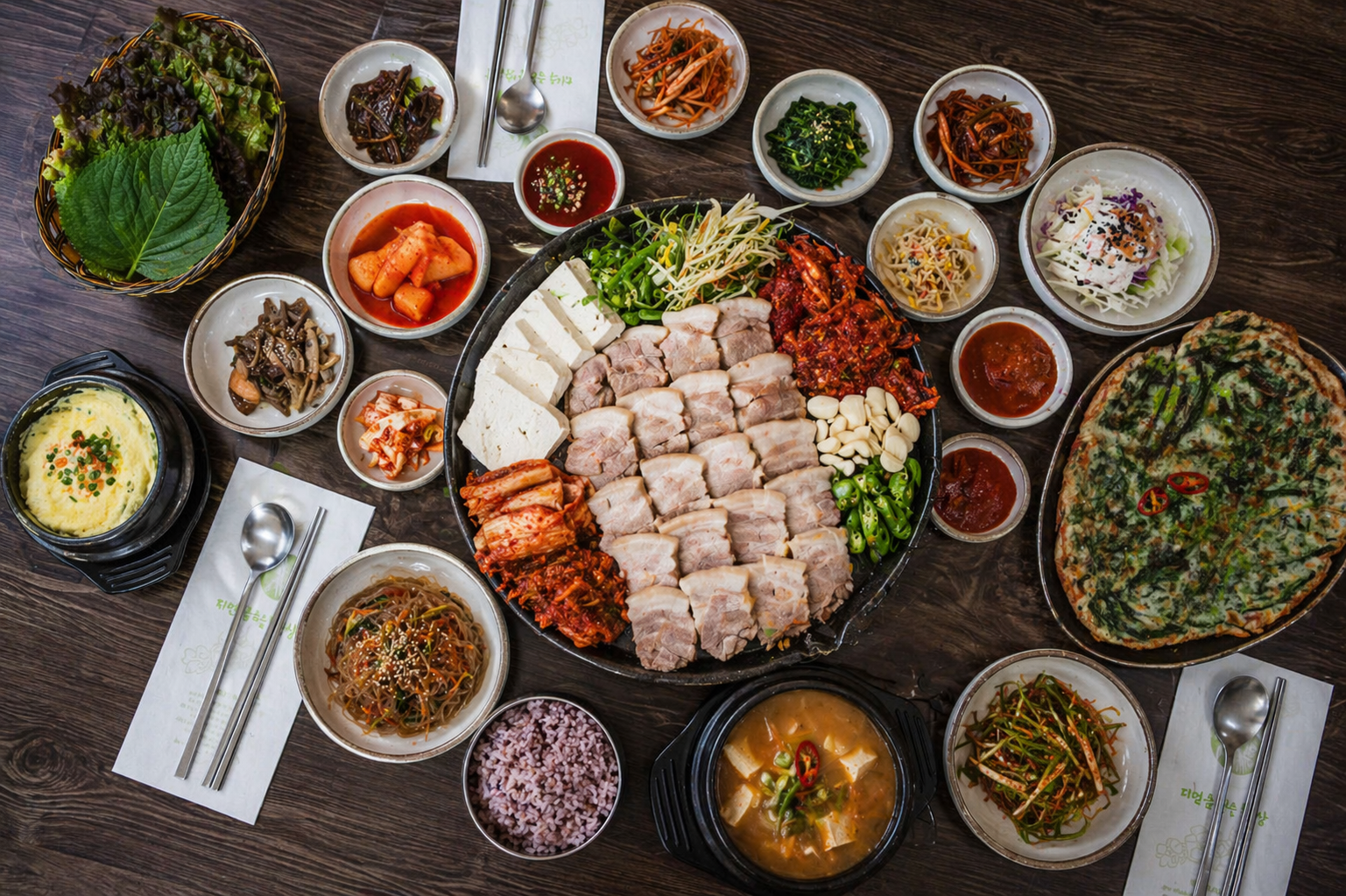
Korean meals almost always include shared banchan (side dishes) at the center of the table. Taking from shared dishes directly is completely normal — that's how Korean meals work. If you want to be a little more considerate, try not to dig around or touch pieces you don't end up taking. Hygiene awareness has increased noticeably since the pandemic, and Koreans appreciate a light touch with shared dishes.
Leaving food on your plate
Unlike some cultures where finishing everything signals appreciation, leaving a small amount of food in Korea is perfectly fine — it can actually signal that you've had enough. Don't force yourself to finish everything out of politeness. Eat what you enjoy, leave what you don't.
Drinking culture etiquette
Korea's drinking culture is lively, social, and has its own set of unspoken rules. If you end up sharing drinks with locals — which is a genuinely great experience — these will serve you well.
Fill others' glasses, not your own
In Korean drinking culture, you don't pour your own drink. You pour for others, and others pour for you. When you notice someone's glass getting low, fill it. When yours is empty, someone else will top it up. It's a deeply communal practice — the sharing of pouring is part of how Koreans build connection over food and drink. If you start filling other people's glasses without being asked, Koreans will notice and appreciate it immediately.
Turn away when drinking in front of elders
This one surprises most visitors. When drinking in the presence of someone older than you, you're expected to turn your body slightly to the side or angle your face away before taking a sip. Drinking directly facing an elder is considered disrespectful. It sounds awkward the first time, but once you try it Korean elders genuinely light up — it's one of those gestures that signals real cultural knowledge, and they love to see it from a foreign visitor.
Receive with two hands
When an elder pours a drink for you, hold your glass with both hands to receive it. One hand extended alone can read as casual or even dismissive in this context. Two hands = respect. This applies whether it's soju, beer, or even tea.
Public transport etiquette
Keep the volume down on the subway
The Seoul subway is one of the quietest public spaces you'll encounter in a major city anywhere in the world. Koreans ride the subway almost entirely in silence — headphones in, eyes on phones, occasionally sleeping. Conversations in normal speaking voice stand out immediately. If you're traveling in a group, keep it to low voices. And no phone speakers — ever. Bring earphones and use them.
Leave the priority seats empty
The designated seats marked in pink or blue are reserved for elderly passengers, pregnant women, and people with disabilities. These seats should stay empty even when the train is full. Koreans will stand for an entire journey rather than sit in a priority seat. Follow their lead.
Let passengers exit before you board
When subway doors open, wait for everyone inside to exit before stepping on. The floor markings outside the doors show exactly where to stand while waiting. It's orderly, efficient, and universally observed. Don't be the person who pushes in before people have finished getting off.
Shopping and store etiquette
Acknowledge the greeting when you enter
When you walk into a small shop or restaurant in Korea, staff will almost always greet you with "어서오세요 (eoseooseyo)" — welcome. A small nod or a quiet "annyeonghaseyo" in return goes a long way. Walking in completely silently without any acknowledgment can feel slightly cold in the context of Korean shop culture. It doesn't have to be much — just a small reciprocal gesture.
Bargaining
Fixed prices are the norm at department stores, chain shops, and most modern retail. At traditional markets and some street stalls, gentle negotiation is possible — but approach it warmly rather than aggressively. A smile and a friendly "can you do a little better?" works far more effectively than demanding a specific price. Koreans respond to warmth in commercial settings just as they do everywhere else.
Temple and traditional spaces
Dress modestly
When visiting Buddhist temples or traditional spaces, very short shorts, sleeveless tops, and overly revealing clothing are best avoided. Some temples provide cover-up garments at the entrance, but it's easier to bring a cardigan or light scarf just in case. This isn't strictly enforced everywhere, but it's a sign of respect for the space that locals notice and appreciate.
Move quietly
Korean Buddhist temples are active places of worship, not just scenic backdrops. Speaking in low voices, moving slowly, and being generally calm is the right approach. Photography is usually fine, but avoid taking selfies with exaggerated poses in front of Buddhist statues, or turning your back to them for photos. Treat the space the way you'd want visitors to treat a place of worship in your own culture.
Remove shoes when indicated
Some temple buildings and traditional spaces require you to remove shoes before entering. If you see a row of shoes at the entrance, that's your signal. Remove yours, line them up neatly, and step inside in socked feet. This also applies to many traditional hanok guesthouses and some restaurants where you sit on floor cushions.
Home visit etiquette
Being invited into a Korean home is a relatively rare experience for visitors, but if the opportunity comes up, it's one of the best things that can happen on a trip.
Bring something
Never arrive empty-handed. Fruit, pastries, a nice box of snacks, drinks — the value isn't the point, the gesture is. Something wrapped nicely from a bakery or a fruit set from a supermarket is completely appropriate. Koreans genuinely appreciate the thought, and showing up with something in hand signals respect for the household.
Remove your shoes at the door
In Korea, shoes come off at the front door — always, without exception. You'll see shoes lined up at the entrance. Remove yours neatly and add them to the line. If slippers are offered, put them on. If not, socked feet are fine inside.
Greet the elders first
If there are older members of the household present, make your way to them first to say hello. A bow and "annyeonghaseyo" is all you need. The fact that a foreign visitor made the effort to greet them directly and respectfully will be remembered warmly long after the visit ends.
Language and communication tips
A few Korean phrases will change your trip
You don't need to speak Korean to have a wonderful time here. But learning a handful of phrases produces a response from locals that English alone simply doesn't. Even imperfect pronunciation is received with genuine warmth — Koreans appreciate the attempt far more than they care about the accent.
안녕하세요 — Annyeonghaseyo — Hello / Good day. Use it entering shops, greeting people, starting any interaction.
감사합니다 — Gamsahamnida — Thank you. The most important phrase you can know. Use it constantly and mean it.
맛있어요 — Masisseoyo — It's delicious. Say this to a restaurant owner or cook and watch their face. It works every single time.
얼마예요? — Eolmayeyo? — How much is it? Useful at markets, street stalls, anywhere prices aren't displayed.
괜찮아요 — Gwaenchanayo — It's okay / I'm fine. Use this to politely decline help or reassure someone who's worried they've inconvenienced you.
Download Papago before you arrive
Papago is a translation app made by Naver — Korea's dominant search platform — and it handles Korean significantly better than Google Translate for most everyday situations. The camera translation feature is especially useful: point your phone at a menu, a sign, or a product label and it translates in real time. Install it before you land. You'll use it constantly.
Final thoughts — Koreans appreciate the effort
None of this needs to be perfect. The list might look long written out, but in practice it comes down to a few instincts: be considerate of the people around you, show respect to older people, and engage with the culture rather than just passing through it.
Korean people respond to genuine effort in a way that I find really moving, honestly. When a foreign visitor bows naturally, uses two hands without being prompted, or says "masisseoyo" to the person who just cooked their meal — the reaction is immediate and warm. It's not about performing etiquette correctly. It's about communicating that you see the culture and you respect it.
You don't need to get everything right. You just need to mean it. Korea will meet you more than halfway. Have an amazing trip!


