Wolmido Incheon travel guide — retro rides, seagulls & seaside grills by a local
🎡 Table of contents
- Intro — Wolmido surprised me completely
- Wolmi Sea Train — book this in advance
- Retro amusement rides — the Disco Pang-Pang experience
- Ferry to Yeongjong Island — and the seagull ambush
- Incheon Chinatown — jajangmyeon and a different kind of Korea
- Wolmi Cultural Street & Wolmi Park — the evening walk
- Korean Immigration History Museum — a hidden gem
- Dinner — shellfish BBQ by the West Sea
- Day trip & 1-night 2-day itineraries
- Getting from Seoul to Wolmido
- Final thoughts — I'm already planning to go back
Intro — Wolmido surprised me completely
I visited Wolmido in Incheon last year without particularly high expectations. It's an hour from Seoul by subway, it has a reputation as a local amusement area, and I assumed it would be a pleasant enough half-day without being anything memorable. I was wrong about that.
What I found was something that Seoul — for all its energy and variety — doesn't really offer: a retro seaside experience that feels like it's from a different era of Korean leisure culture. Vintage-style amusement rides, a monorail running along the coast, seagulls descending in terrifying numbers for shrimp crackers, a Chinese-heritage neighborhood right next door, and shellfish grilling by the West Sea as the sun goes down. It all came together into a day that was genuinely unexpected and completely enjoyable. I liked it so much I'm planning an overnight stay this year.
For international visitors who've done the Seoul circuit and want something different — something with a distinct local character that isn't on most tourist itineraries — Wolmido is the recommendation I'd make with genuine enthusiasm.
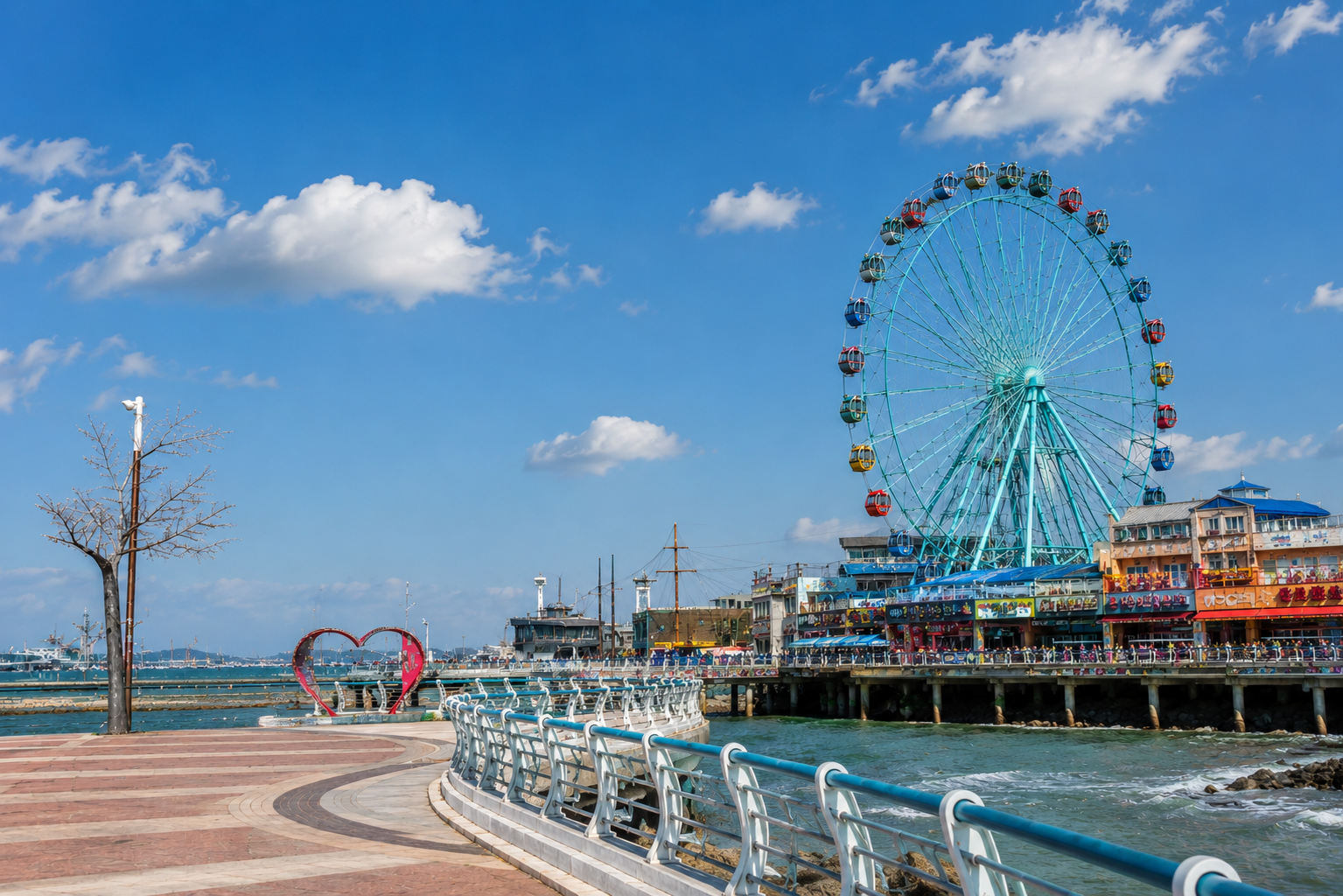
Wolmi Sea Train — book this in advance
The Sea Train (월미바다열차) is Wolmido's signature experience — a monorail that runs from Incheon Station along the coast, offering views of the West Sea, Incheon Port, the port's famous Silo mural (a Guinness record-holding mural painted on an enormous grain storage building), and the Incheon Bridge. Running along the coastline at elevation, it gives you a view of the area that no other mode of transport replicates.
I didn't get to ride it last year — I hadn't booked in advance and it was sold out. This is the lesson I'm passing on: book online before you go, especially on weekends. Walk-up tickets are available but can sell out during busy periods. The main boarding point is Wolmi Sea Station (월미바다역) near Incheon Station, which is also the most convenient for public transit arrivals. Adult fare is ₩8,000, children ₩5,000. Note that it's closed on Mondays — check before you plan your visit around it.
Sea Train essentials: Adult ₩8,000 / Child ₩5,000. Online advance booking strongly recommended on weekends. Closed Mondays. Board at Wolmi Sea Station near Incheon Station.
Retro amusement rides — the Disco Pang-Pang experience
Wolmido has six amusement parks clustered together — Wolmi Theme Park, My Land, Bi-chwi Land, Wolmi Land, Viking Rides, and more. None of them are trying to compete with Everland or Lotte World, and that's entirely the point. The rides here are older, louder, more chaotic, and significantly more charming for all of that. The whole area has an atmosphere that feels like Korean leisure culture from several decades ago, preserved and still operating, and visitors who go in with the right spirit find it completely delightful.
The standout experience is the Disco Pang-Pang (디스코팡팡) — a spinning ride controlled by a DJ who narrates and jokes into a microphone throughout, playing music and adjusting the speed based on crowd response. The atmosphere it creates is unlike any theme park ride you've been on before. International visitors consistently find it baffling and hilarious in the best possible way. There are also Viking-style swing rides, family-friendly options for children, and various other attractions across the cluster. No long queues — just walk up, pay per ride, and go.
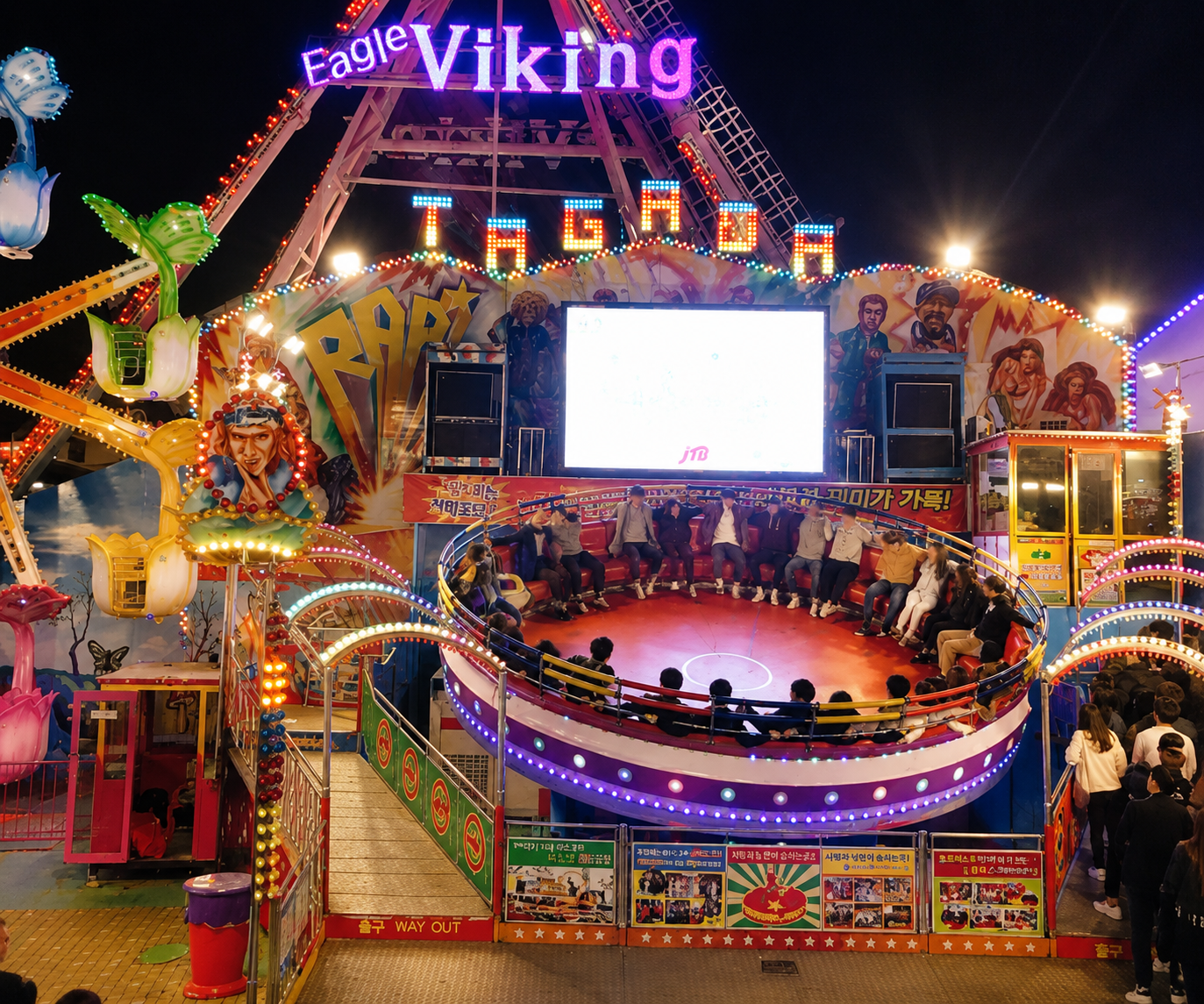
Wolmido Disco Pang-Pang
Ferry to Yeongjong Island — and the seagull ambush
From Wolmido's pier, you can take a ferry across to Yeongjong Island — the island where Incheon Airport is located. The crossing itself is a pleasant short voyage, but the real event happens the moment you step onto the upper deck with a bag of shrimp crackers (새우깡, saeukkang).
The seagulls at Wolmido know about the shrimp crackers. They descend immediately, in significant numbers, at close range. I found this both exhilarating and genuinely alarming — the scale of the birds and how closely they'll approach is something that catches most people off guard. The proper response is to keep throwing crackers and laugh. It's one of those chaotic, unscripted moments that becomes a story you tell afterward.
For a more extended sea experience, the cruise option circles Yeongjong Island and Jakak Island, passes under the Yeongjong Bridge, and returns to Wolmido in about 80 minutes, with onboard entertainment and the open West Sea views the whole way. Either option — the simple ferry crossing or the full cruise — makes the pier visit worthwhile on its own.
Incheon Chinatown — jajangmyeon and a different kind of Korea
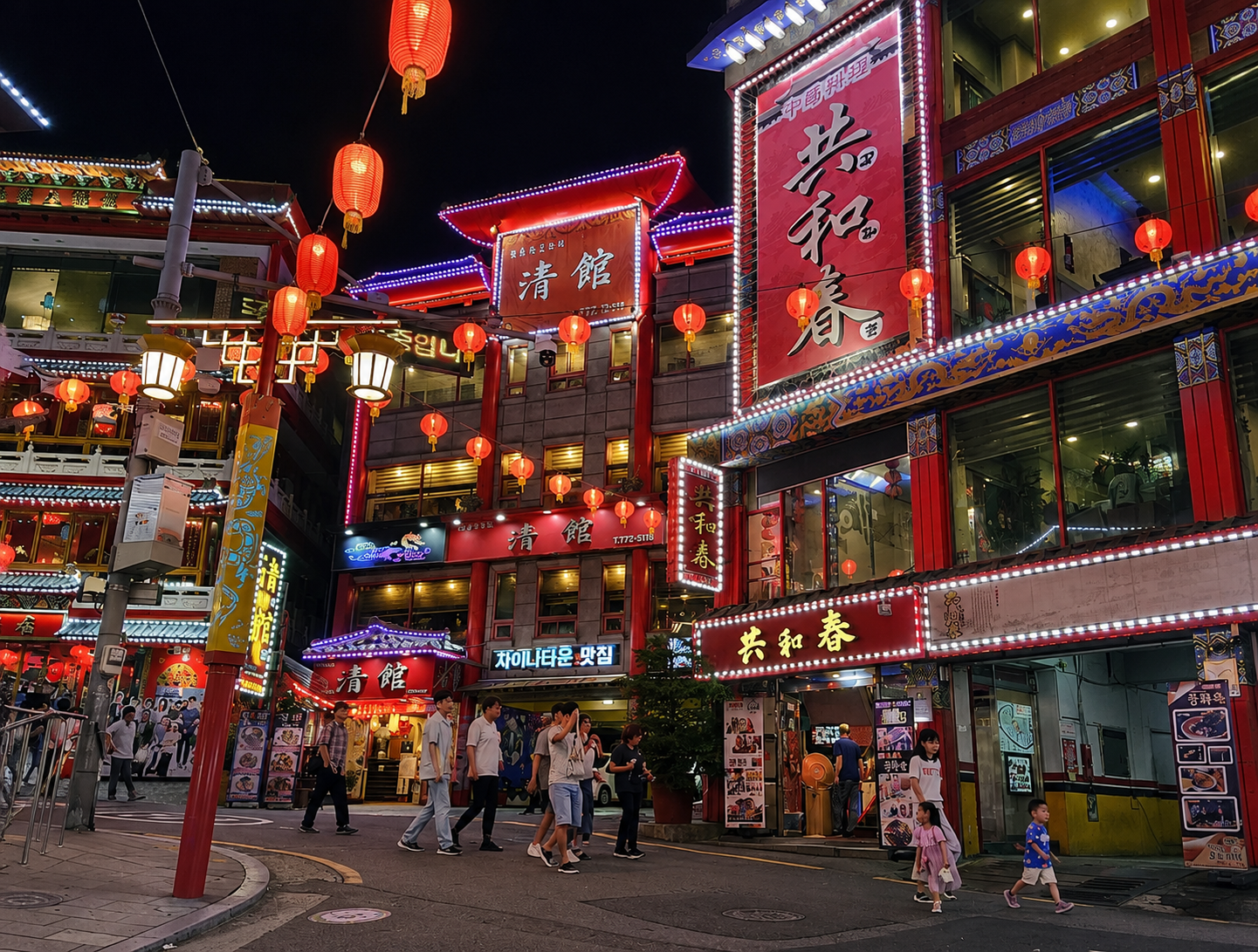
Incheon's Chinatown is immediately adjacent to Wolmido — walkable in minutes — and it's Korea's oldest and most established Chinese heritage neighborhood. Red architecture, Chinese-language signage, the smell of black bean sauce in the air — it's visually and atmospherically distinct from anything else in the Seoul metropolitan area. I had lunch here last year and it was genuinely excellent.
The food to order is jajangmyeon (짜장면) — black bean noodles, and specifically here, because this is where the dish originated in Korea. Chinese immigrants adapted it in Incheon in the early 20th century, and it became one of the most beloved foods in the entire country. Eating it here, in the neighborhood where it was created, has a particular significance. The historic restaurant Gonghwachun is the most famous address. Next to Chinatown, the Jajangmyeon Museum documents this culinary history with genuine depth — worth a look if you find yourself interested in food culture. The Three Kingdoms mural street nearby is also photogenic and worth a walk through.
Wolmi Cultural Street & Wolmi Park — the evening walk
Wolmi Cultural Street (월미문화의거리) is a 600-meter seaside promenade lined with seafood restaurants and cafés facing the West Sea. A musical fountain, outdoor foot bath (해수족탕, seawater foot soak), and outdoor stage punctuate the walk. In the evening, as the sky changes over the water and the lights come on, it becomes one of the more atmospheric seaside walks near Seoul — the combination of the Incheon Bridge visible in the distance and the gentle movement of the water has a quality that makes you slow down naturally.
Wolmi Park centers on Wolmisan Mountain (108 meters) and includes a summit observatory, a traditional Korean garden, and well-maintained forest walking trails. The view from the observatory takes in the West Sea islands, Incheon Bridge, and Yeongjong Bridge simultaneously. A small electric shuttle vehicle called the "Mulbeom-ka" runs from the park entrance to the summit every 20 minutes between 10am and 5pm — useful if you'd rather not climb. The park is particularly beautiful in April when cherry blossoms line the paths.
Korean Immigration History Museum — a hidden gem
Most visitors to Wolmido don't know this museum exists, and the ones who find it are consistently glad they did. The Korean Immigration History Museum (한국이민사박물관) documents the story of Korean emigration beginning with the first group of 102 immigrants who left Incheon Port for Honolulu, Hawaii in 1903. Incheon was the departure point for generations of Koreans who left in search of a different life, and the museum tells their stories with care and emotional weight. Entry is free. The exhibition quality is genuinely high. If you have any interest in social history or the Korean diaspora, this is a meaningful hour.
Dinner — shellfish BBQ by the West Sea
The dinner I'd recommend for any Wolmido visit — and the one I had last year that I'm still thinking about — is shellfish BBQ (조개구이, jogae-gui) at one of the restaurants along the waterfront. Fresh clams, scallops, cockles, and other shellfish arrive raw on a charcoal grill at your table, and you cook them yourself as the shells open and the juices pool. The combination of the sea air, the sound of the shells crackling over charcoal, and the West Sea sunset visible from your table produces a dining atmosphere that's very specific to this kind of Korean coastal restaurant and genuinely difficult to replicate anywhere else.
The waterfront restaurants along Wolmi Cultural Street serve this, as do various spots scattered through the Wolmido area. Prices are a step above city-center rates — this is a tourist-facing area and the pricing reflects that — but the freshness of the shellfish and the setting make it worthwhile. If you're staying overnight, this is the dinner to plan the whole evening around. Time it with the West Sea sunset.
Day trip & 1-night 2-day itineraries
Day trip from Seoul
Morning — Arrive Incheon Station → Wolmi Sea Train (advance booking essential)
Lunch — Incheon Chinatown jajangmyeon
Afternoon — Wolmido amusement rides (Disco Pang-Pang, Viking) → Pier ferry to Yeongjong Island + seagull shrimp cracker experience
Evening — Wolmi Cultural Street sunset walk → shellfish BBQ dinner
Return to Seoul
1-night 2-day
Day 1 — Arrive Incheon → Chinatown & Jajangmyeon Museum → Wolmi Sea Train → Wolmido amusement rides → Wolmi Cultural Street sunset → shellfish BBQ dinner → overnight in Wolmido area
Day 2 — Wolmi Park forest walk & observatory → Korean Immigration History Museum → pier cruise (Yeongjong Island + seagulls) → return to Seoul
Wolmido tips: Sea Train advance booking essential on weekends · Closed Mondays · Seawater foot bath and musical fountain are free · Time shellfish dinner with the West Sea sunset · Chinatown is walkable from Wolmido pier
Getting from Seoul to Wolmido
Subway is the most convenient option. Take Line 1 from Seoul Station to Incheon Station — approximately 70 minutes. From Incheon Station, Wolmido Cultural Street is about 2.5km: 15 minutes by bus or 30 minutes on foot. If you're riding the Sea Train, the Wolmi Sea Station is right next to Incheon Station — the most convenient starting point for public transit arrivals.
By car from Seoul it's about an hour. Parking on busy weekends can be complicated — public transit is the easier option unless you're specifically planning to drive further on to Yeongjong Island or the Incheon area.
Final thoughts — I'm already planning to go back
Wolmido occupies a particular space in the Korean travel landscape — not spectacular in the way that major tourist destinations are spectacular, but possessed of a charm and a local character that's increasingly rare. The retro amusement park culture, the seagull chaos on the ferry, the Chinatown neighborhood with its specific food history, the shellfish dinner as the sun sets over the West Sea — none of these are experiences that Seoul's main attractions offer.
I went last year expecting a pleasant enough day and came home having genuinely enjoyed myself. I liked it enough that I'm planning an overnight stay this year — to slow it down, catch the evening atmosphere more fully, and get the Sea Train I missed last time. If you're in Seoul and looking for a day trip that feels completely different from the capital, Wolmido is where I'd send you. Have an amazing trip! 🎡
'Korea Travel Tips' 카테고리의 다른 글
| What not to do in Korea — a local's honest guide to Korean etiquette (1) | 2026.05.28 |
|---|---|
| Where to Go Hiking in Seoul? — Achasan, Bukhansan & More (0) | 2026.05.26 |
| Peak Seasons to Reconsider: Avoiding the Crowds in Korea (0) | 2026.05.22 |
| Where to Eat Bingsu in Seoul — Mango, Sulbing & Local Picks (0) | 2026.05.20 |
| When Is the Best Time to Visit Korea? — A Local's Honest Month-by-Month Guide (0) | 2026.05.18 |


